Understanding Burnout: Signs and Proven Recovery Strategies

Burnout has the potential to impact individuals from every background and lifestyle imaginable. This multifaceted challenge is frequently linked to excessive workloads, particularly affecting people in highly intense and high-pressure corporate environments. However, it is far from an issue that onl
Burnout has the potential to impact individuals from every background and lifestyle imaginable.
This multifaceted challenge is frequently linked to excessive workloads, particularly affecting people in highly intense and high-pressure corporate environments.
However, it is far from an issue that only touches a privileged minority. Anyone can experience it, and it does not always arise solely from putting in excessive hours on the job.
The World Health Organization (WHO) provides a clear definition of burnout as a syndrome characterized by intense energy depletion or extreme fatigue; a growing mental detachment from one's occupation, or developing negativism or cynicism toward one's profession; and a noticeable decline in professional performance.
Far beyond mere physical tiredness, the WHO's characterization emphasizes a profound sense of indifference or apathy, where activities feel devoid of purpose. Importantly, it is not triggered by the sheer volume of work hours but rather by the underlying emotional responses to those demands.
We commonly view burnout as a major hindrance to our output and efficiency, something we must push past or endure. Thoughts like 'If only I weren't so burned out, I could accomplish this' are all too familiar. Yet, reframing it through this updated lens positions burnout as an emotional barrier that we can proactively sidestep.
By fostering positive emotions, we can sustain high levels of productivity without allowing burnout to derail our progress abruptly.
In essence, burnout serves as an emotional indicator alerting us that our present method of handling work is not viable in the long term.
Addressing Burnout Effectively
This comprehensive guide explores the various manifestations of burnout, delves into its root causes, and outlines practical methods to counteract it successfully.
By the end, you will possess a robust toolkit of strategies to tackle burnout head-on. The good news is that it is both manageable and, crucially, avoidable with the right approaches.
Identifying Burnout Early
Here is a detailed compilation of indicators and symptoms that can assist in spotting the onset of burnout:
- Sensing profound apathy or viewing your professional tasks as pointless
- Encountering intense emotional overload
- Feeling utterly sapped of vitality
- Juggling too many competing demands simultaneously
- Finding it arduous to complete a standard workday
- Craving to collapse on the couch and disengage completely after hours
- Feeling ill-prepared to face daily challenges
- Battling persistent guilt and an unrelenting urge to labor nonstop
Acknowledging the early signs of emotional or physical drain is a vital initial measure in halting the progression to severe burnout. This vigilance is particularly essential during extended, high-stakes endeavors like launching a business or managing a side project. Regularly monitor your physical health and emotional state, and seek support without delay if you notice yourself faltering.
Burnout extends well beyond simple fatigue. As evident from the symptoms listed, it encompasses a broader spectrum of emotional and psychological strains.
If several of these resonate strongly with your current experience, it signals the need to explore targeted remedies. Yet, to do so effectively, we must first uncover the underlying triggers.
The Three Distinct Categories of Burnout
A structured approach to pinpointing burnout's origins involves examining its three primary categories, as outlined in the book Feel-Good Productivity:
- Overexertion burnout
- Depletion burnout
- Misalignment burnout
Grasping the specific type fueling your burnout paves the way for tailored interventions.
1. Overexertion Burnout
True to its name, this form arises from pushing ourselves beyond reasonable limits: assuming excessive duties without incorporating adequate recovery periods.
You could be habitually accepting extra assignments without pushback.
Constant demands to hit unattainable timelines might be wearing you down.
Maybe you're ensnared in endless chains of exhausting consecutive meetings.
Such unyielding work rhythms can evoke overwhelming sensations and deep emotional fatigue. The COVID-19 era witnessed a surge in this variety, dubbed Zoom fatigue, where prolonged virtual interactions overloaded cognitive capacities, demanding essential cooldown phases.
Overloading our schedules often breeds panic and disorientation. Resorting to mental shutdowns or forcing progression through the day only exacerbates the distress.
2. Depletion Burnout
In contrast to overexertion, depletion burnout emerges from inadequate replenishment despite a balanced workload.
Even with reasonable tasks, sustainable routines, and pleasant workdays, neglecting restoration can lead to this state.
Habits like endless social media scrolling, obsessive email monitoring, or marathon sessions of mindless television deprive us of true recovery. Overloading the mind with stimuli prevents natural recharging, resulting in persistent exhaustion.
3. Misalignment Burnout
This category surfaces when our efforts clash with our core principles. Our objectives fail to harmonize with our personal identity.
A typical scenario involves enduring long hours in a lucrative role that feels profoundly empty—perhaps due to conflicting company ethics or sheer disinterest. Even standard schedules can torment if the role lacks purpose.
Frequently, this stems from extrinsic drivers overriding intrinsic passions, like chasing promotions at the expense of cherished creative outlets.
The core issue is inauthenticity, disconnecting us from our true selves and fostering dissatisfaction and lack of drive.
Strategies for Overcoming Burnout
Having pinpointed your burnout type, apply these three core principles for recovery:
- Conserve – ideal for overexertion scenarios
- Recharge – suited for depletion states
- Align – targeted at misalignment issues
This forms the CRAB framework: Conserve, Recharge, Align, and Beat burnout.
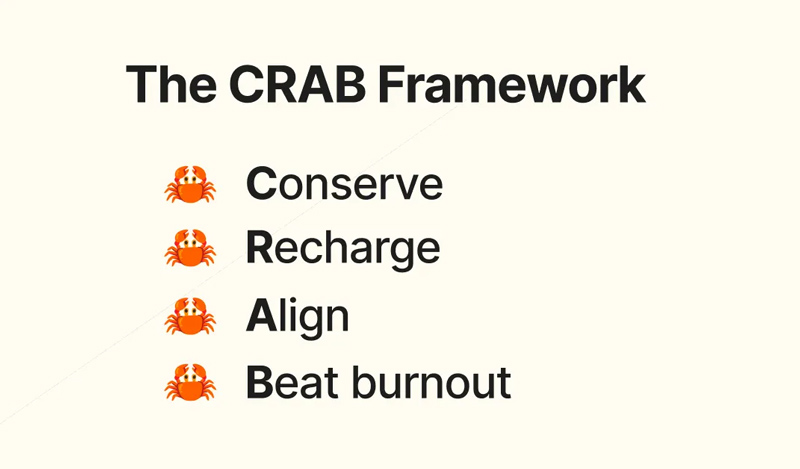
These principles not only facilitate rebound from emotional lows but also instill habits that safeguard against future episodes, promoting enduring work sustainability.
Principle 1: Conserve
Countering overexertion requires deliberate energy preservation while maintaining output.
This entails honoring your time and energy boundaries through protective measures against exhaustion.
Here are three practical tactics to safeguard your energy:
1. Do Less
Begin with a paradigm shift: prioritize depth over breadth by selecting fewer pursuits and excelling in them.
Consider opportunity cost—the notion that every 'yes' implies a 'no' elsewhere. Embrace saying 'no' to elevate focus on high-priority endeavors.
Initial discomfort is common, so adopt Derek Sivers' 'Hell Yeah or No' rule: default to 'no' unless it sparks enthusiastic excitement.
This curtails overload, enhances execution quality, and steers you toward genuinely fulfilling pursuits.
2. Optimize Your Environment
Your physical and digital surroundings profoundly influence energy. Clutter breeds chaos; preempt it by decluttering proactively.
Tidy your desk, ensuring essentials are at hand.
Cultivate focus by silencing notifications, closing extraneous tabs, and employing blockers like Opal.
Infuse positivity with soothing music or greenery to foster calm readiness.
3. Embrace Breaks
Scheduled pauses are essential for energy sustainability.
Reframe breaks as mandatory, not earned rewards—prioritize them inherently.
Tailor durations and pursuits: a park stroll, brief meditation, or simple hydration stretch. Experiment to discover your optimal rhythm.
Principle 2: Recharge
For depletion, emphasize restoration post-exertion via invigorating pursuits that renew rather than drain.
Try these three recharging methods:
1. Embrace Creativity
Deep creative immersion dissolves stress, engaging novel neural pathways for relaxation.
The CALM acronym captures its benefits: Competence from skill-building accomplishments; Autonomy via self-directed expression countering external pressures; Liberty through escapist immersion; Mellowness in low-pressure enjoyment.
Select hobbies aligning with these elements for maximal recharge.
2. Reconnect with Nature
Nature swiftly alleviates stress and revitalizes.
Short exposures, even seven minutes amid greenery, yield profound renewal. Daily green walks enhance clarity, stress reduction, and concentration.
When outdoors access is limited, import nature: plants, landscapes, or wallpapers simulate benefits effectively.
3. Practice Self-Care
For total exhaustion, opt for Mindless Recharging—effortless activities like TV binges or casual scrolling, in moderation.
This 'unproductive' interlude resets without pressure. Invoke the Reitoff Principle: freely abandon remaining time when drained, guilt-free, affirming rest as peak productivity.
Principle 3: Align
Mitigate misalignment by harmonizing work with intrinsic identity, fostering fulfillment alongside productivity.
Challenges like unfulfilling roles persist, yet incremental syncing is feasible. Implement these three alignment tactics:
1. Journaling
Self-inquiry via journaling clarifies values: What matters most? What principles guide you? What deserves priority?
Iterative reflection yields self-insight, revealing discrepancies. Probe emotions, origins, and remedies for discord.
2. Goal Setting
With values defined, direct actions accordingly. Daily choices either advance or erode alignment, often unconsciously—like freedom-lovers in rigid jobs or relationship-prioritizers overworking.
Counter with three value-aligned quests daily: one for work (e.g., brighten a colleague's day), health (e.g., lunch walk), relationships (e.g., plan a movie outing).
These micro-wins nudge you toward value-centric living.
3. Authenticity Experiments
Authenticity entails decisions rooted in personal conviction over external expectations.
Research links daily authenticity to heightened happiness and engagement. Apply experimentally: identify dissatisfaction domains, hypothesize single tweaks (e.g., sunlit coffee for morning vitality), implement, assess authenticity impact, log results.
This iterative, low-risk method refines alignment sans radical upheaval.
Achieving Lasting Freedom from Burnout
Burnout's complexity transcends overtime alone, signaling unsustainable emotional, physical, or mental strain.
Categorizing into overexertion, depletion, and misalignment empowers preemptive action against limits.
Should burnout strike, conserve, recharge, and align to rebound and fortify resilience, ensuring sustained well-being.
Subscribe to the newsletter
Join 50,000+ others who get our content first. No spam, ever.