Procrastination's Daily Life Impact and Solutions

Understanding the Timeless Struggle with ProcrastinationProcrastination represents a persistent hurdle that has plagued humanity since ancient times. Even the thinkers of Ancient Greece coined a specific word for it: 'akrasia,' which refers to the tendency to act against one's own rational judgment
Understanding the Timeless Struggle with Procrastination
Procrastination represents a persistent hurdle that has plagued humanity since ancient times. Even the thinkers of Ancient Greece coined a specific word for it: 'akrasia,' which refers to the tendency to act against one's own rational judgment by delaying important actions.
In the modern era, this issue seems even more daunting due to the overwhelming array of digital temptations that constantly vie for our attention, making it increasingly difficult to accomplish what truly matters.
At the heart of procrastination lies a psychological phenomenon known as present bias. This concept explains how we readily establish ambitious objectives for our future selves, yet it is the current version of ourselves that must muster the effort to execute them right now.
Regrettably, our immediate self often favors quick, fleeting gratifications over choices that promise greater long-term advantages. For instance, when faced with the decision between heading to the gym for a workout or settling in for an extended session of binge-watching a beloved television series, we overwhelmingly opt for the latter, despite recognizing that physical exercise would yield superior benefits down the line.
This present bias renders the allure of television viewing irresistibly attractive in the moment, ensuring that our future self rarely builds the gym routine we intend. Throughout this comprehensive guide, we will delve deeply into the underlying triggers of procrastination and equip you with a wealth of practical strategies and techniques to conquer it, enabling you to maximize the potential of every single day in your life.
Exploring the Root Causes of Procrastination
Renowned procrastination researcher Dr. Tim Pychyl, in his insightful 2013 study, pinpointed that the primary driver behind procrastination frequently originates from an innate urge to evade the uncomfortable emotions tied to undertaking certain tasks.
Whenever a responsibility appears overwhelming, intricate, or excessively demanding, we instinctively seek to sidestep the accompanying sensations of anxiety, frustration, and bewilderment by postponing engagement with it entirely.
In essence, procrastination serves as a temporary mechanism for regulating our emotional state in the here and now, rather than channeling our energy into fulfilling obligations that align with our broader, enduring aspirations.
On a logical level, every individual recognizes the detrimental effects of procrastination on personal progress and well-being, yet this awareness seldom prevents us from succumbing to it repeatedly.
The compulsion to dodge those adverse emotions proves more potent than our rational impulse to complete the work at hand. Confronting these unpleasant sentiments can feel profoundly challenging, prompting us to circumvent the task completely and immerse ourselves in diversions such as television marathons, endless social media browsing, or any other instantaneous reprieve available.
Engaging in procrastination this way fosters a profound internal tug-of-war between the instant pleasures derived from leisurely pursuits and the rigors associated with tackling demanding endeavors. We gravitate toward the ephemeral thrills of gaming sessions instead of steadily advancing toward our more substantial, distant objectives.
This dynamic creates a vexing limbo wherein we intellectually grasp the damage wrought by our delays, yet we persistently revert to the same patterns. The encouraging reality is that effective countermeasures exist. Over recent years, I have formulated a straightforward yet powerful equation designed to eradicate procrastination from your routine permanently.
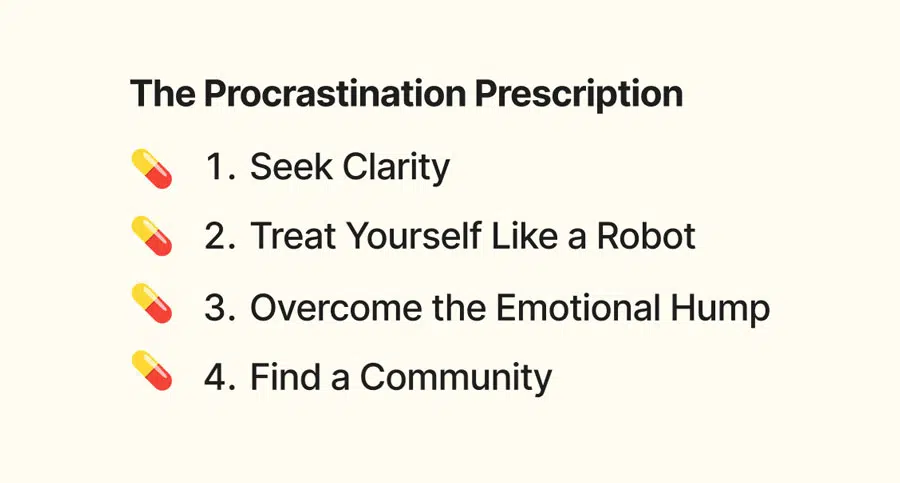
The Procrastination Prescription: A Four-Step Remedy
Introducing the Procrastination Prescription, a meticulously crafted four-step framework that has proven instrumental in helping individuals eradicate procrastination once and for all:
- Seek Clarity
- Treat Yourself Like a Robot
- Overcome the Emotional Hump
- Find a Community
Each of these essential steps incorporates two actionable, hands-on recommendations tailored to empower you in defeating procrastination decisively.
Step 1: Seek Clarity to Eliminate Uncertainty
One peculiar aspect of procrastination is that it becomes untenable in scenarios where immediate action is non-negotiable. In moments of true urgency or peril, the mere notion of delay does not even arise in our consciousness.
The perceived criticality of such imperatives supersedes any inclination toward postponement. Conversely, when stakes feel lower, we are far more prone to deferring responsibilities to a later time, rationalizing with phrases like 'I'll handle it tomorrow.'
This behavior stems from what experts term uncertainty paralysis. Absolute conviction in a task's necessity quells any procrastination impulse entirely. However, ambiguity regarding the rationale behind a duty significantly hampers our drive to initiate it.
Therefore, to dispel this paralysis, we must actively pursue clarity, grasping both the profound purpose of the task and the concrete sequence of actions required for its completion.
Uncertainty can also manifest in confusion over the task's specifics. Lack of clear comprehension about what needs to be done, or obscurity in the immediate next steps, breeds discomfort, as humans generally resist venturing into uncharted territory.
This unease frequently precipitates procrastination, as we shy away from commencing endeavors whose endpoints remain elusive. By attaining crystal-clear insight into both the 'why' and the 'how' of our responsibilities, we effectively neutralize the emotional barriers fueling our delays.
Practical Tip 1: Employ the 5 Whys Technique
When grappling with uncertainty paralysis, a proven method to alleviate associated anxiety involves applying the '5 Whys' approach. This structured problem-solving technique entails iteratively questioning 'why'—typically five iterations—to unearth the fundamental concern at play.
Consider a scenario where you are delaying work on a significant project. Rather than self-flagellating with labels like 'lazy' or 'unmotivated,' commence the inquiry: Why am I avoiding this essay? Perhaps because initiating it triggers intense anxiety.
Why the anxiety upon starting? Due to fears that it may fall short of perfection. Why such perfectionism concerns? Because potential ridicule from others if it's subpar terrifies me, given past stinging feedback.
Why does criticism affect me so deeply? Repeated negative responses have eroded my self-assurance over time. Why the confidence erosion? Because I invest tremendous effort and crave acknowledgment for it.
Through this layered interrogation, the true crux emerges: the apprehension centers not on essay composition per se, but on the absence of validation. Armed with this revelation, targeted remedies become possible, such as self-affirmation of efforts or seeking affirmation from intimate circles independent of external critiques.
Practical Tip 2: Cultivate a Growth Mindset
Another avenue to clarity involves recalibrating your overall mindset, encompassing thoughts, emotions, and attitudes toward challenges. Conquering procrastination transcends mere willpower exertion amid emotional turmoil; it demands holistic alignment in perceiving tasks and their ramifications.
Achieve this through fostering a growth mindset, which posits that abilities and intelligence evolve via dedicated effort, learning, and resilience. This perspective can be distilled into a foundational equation: Thoughts & Feelings shape Decisions, which propel Actions, ultimately yielding Results.
Thoughts and feelings profoundly dictate choices, actions, and outcomes, yet they can obscure objective assessment. By first surfacing and examining prevailing mental states, we realign emotions toward sustained objectives.
For example, counter self-defeating declarations like 'I can't do this' by interrogating and reframing them positively—perhaps 'I can't do it yet' or viewing the task as a valuable learning prospect. This emotional pivot facilitates superior decision-making, invigorates purposeful actions, and heightens success probabilities.
Embracing a growth mindset revolutionizes productivity paradigms entirely, fostering resilience against procrastination's pull.
Step 2: Treat Yourself Like a Robot for Objective Progress
Having clarified procrastination triggers, the subsequent phase entails adopting a robotic persona toward yourself. When endeavors falter, resist emotional frustration impulses.
Instead, emulate troubleshooting a glitchy automaton: dissect malfunctions logically, pinpoint inefficiencies, and iteratively refine strategies sans self-reproach. This vantage reframes procrastination as constructive feedback, an opportunity to enhance your productivity architecture.
Divorcing emotion from analysis promotes dispassionate problem resolution, circumventing demoralization traps.
Practical Tip 3: Construct Your Personal Algorithm
Envision yourself as a programmable robot under your exclusive control. No prudent operator permits arbitrary daily directives; instead, they instill rigorous protocols optimizing peak performance.
Mirror this by engineering a bespoke algorithm—a sequence of rituals priming your optimal state. Examples abound: meticulously making your bed upon waking, dedicating five minutes to reflective journaling, or hydrating while coffee percolates.
Tailor to perceived needs. Automation of success enablers minimizes procrastination risks, decoupling action from motivation dependency. Adhering to this code renders productivity habitual, akin to automated machinery execution.
Practical Tip 4: Replace 'And' with 'Or' for Flexibility
Elevate your algorithm by supplanting conjunctive 'and' with disjunctive 'or' in precondition narratives. Procrastination thrives on perfectionist prerequisites: 'I'll commence post-sufficient sleep and coffee and household tidying.'
This 'and' chain stifles initiation. Pivot to 'or': 'I'll exercise if energized or weather favorable or time available.' This linguistic nuance multiplies viable entry points, obviating perfect alignment necessities.
More pathways equate to amplified action likelihoods, preemptively conquering procrastination's inertia half the battle.
Step 3: Overcome the Emotional Hump with Momentum
Inevitable instances arise where procrastination proves unavoidable, confronting us with obligatory yet repugnant tasks sans alternatives. Negative emotions persist unrelentingly, manifesting as an insurmountable emotional barrier halting progress.
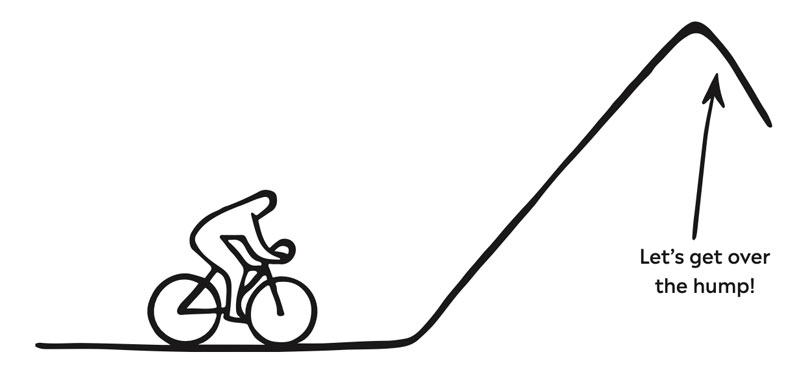
Critically, the paramount obstacle resides not in task execution proper, but surmounting that precipitous emotional incline impeding startup. That insidious inner monologue whispering 'Not now' encapsulates universal inertia.
We languish in motivational morass, burdens amplified. Mastery demands emotional circumvention, propelling past primal resistance into productive flow.
Practical Tip 5: Utilize a 5-Minute Sand Timer
Echoing Newtonian inertia—stationary objects resist motion, moving ones perpetuate—it analogizes human stasis. Couch-bound scrolling sustains ruts far easier than task commencement.
Counter with a 5-minute timer stratagem: invert it, pledging sole commitment to initial five minutes, obligation-free thereafter. Invariably, inception dissolves dread; perceived horrors evaporate, momentum accrues organically.
Motion begets motion; perfunctory starts burgeon into sustained sessions, transmuting dread into accomplishment sans preconditioned zeal.
Practical Tip 6: Apply the Reitoff Principle
When emotional barricades loom impregnably, invoke the Reitoff Principle: sanction deliberate unproductive interludes as strategic recharges. Self-laceration avails naught; embrace respite guiltlessly.
Conceive as pit stops replenishing depleted reserves—indulge favored episodes, ambulatory excursions, or restorative naps. Validate rest's intrinsic value; self-compassion catalyzes rebounds.
Temporal retreats paradoxically accelerate net advancement, honoring human rhythms over Sisyphean grinds.
Step 4: Find a Community for Collective Strength
Solitary rumination amplifies procrastination's emotional toll; communal solidarity proffers antidotes. Isolation mirrors futile self-extrication from mire; external alliances catalyze escape.
Trusted confidants, workplace peers, or virtual cohorts furnish indispensable outlets for catharsis, triumphs, setbacks, and perspectives. Such environs replenish depleted motivational reservoirs.
Practical Tip 7: Secure an Accountability Buddy
Leverage interpersonal dynamics: fidelity to others eclipses self-promises, rooted in social reciprocity aversions. Pair with compatible allies—kinsmen, coworkers, or affinity strangers—for mutual oversight.
This engenders 'comrade mindset,' transmuting solitary toil into collaborative stakes. A 2014 study evidenced teammates' obligation extending task endurance by 48%. Backed thusly, daunting duties diminish insurmountably.
Practical Tip 8: Engage in a Productivity Lab
Immerse in affinity collectives cultivating vicarious mastery—observing peers' triumphs vicariously bolsters self-efficacy. Empirical research affirms experiential exchanges accelerate personal breakthroughs by proxy.
Such synergies profoundly amplify outputs, as manifested in dedicated forums like productivity labs, veritable dojos for iterative experimentation, progress monitoring, and strategy refinement amid supportive networks.
There concludes the Procrastination Prescription—an arsenal empowering perennial victory over delay's grip, unlocking daily life's fullest realization.
Subscribe to the newsletter
Join 50,000+ others who get our content first. No spam, ever.