Build an Effective Time Management Routine

Many individuals struggle to allocate consistent time for the pursuits that genuinely bring them happiness. Juggling professional responsibilities, family commitments, social interactions, health maintenance, and personal side endeavors often makes it feel utterly impossible to accommodate everythin
Many individuals struggle to allocate consistent time for the pursuits that genuinely bring them happiness. Juggling professional responsibilities, family commitments, social interactions, health maintenance, and personal side endeavors often makes it feel utterly impossible to accommodate everything on our agendas.
In reality, absent a robust framework, our hours evaporate unnoticed. This leaves us with a nagging sense of stagnation amid perpetually expanding lists of unfinished tasks.
Imagine, however, seizing command over your daily schedule, intentionally reserving slots not only for mandatory duties but also for those enriching experiences that spark joy and a profound sense of accomplishment.
The key lies in honing the art of time management. Establishing a thoughtfully designed time management routine empowers you to dedicate periods for concentrated, meaningful endeavors while simultaneously preserving space for leisure pursuits—or even indulging in video games, as I personally do.
Over numerous years, I have tested a wide array of time management techniques. Through extensive experimentation, marked by both successes and numerous missteps, I have pinpointed the approaches that deliver results and those that fall short. Within this guide, I outline my seven reliable steps to construct a time management routine:
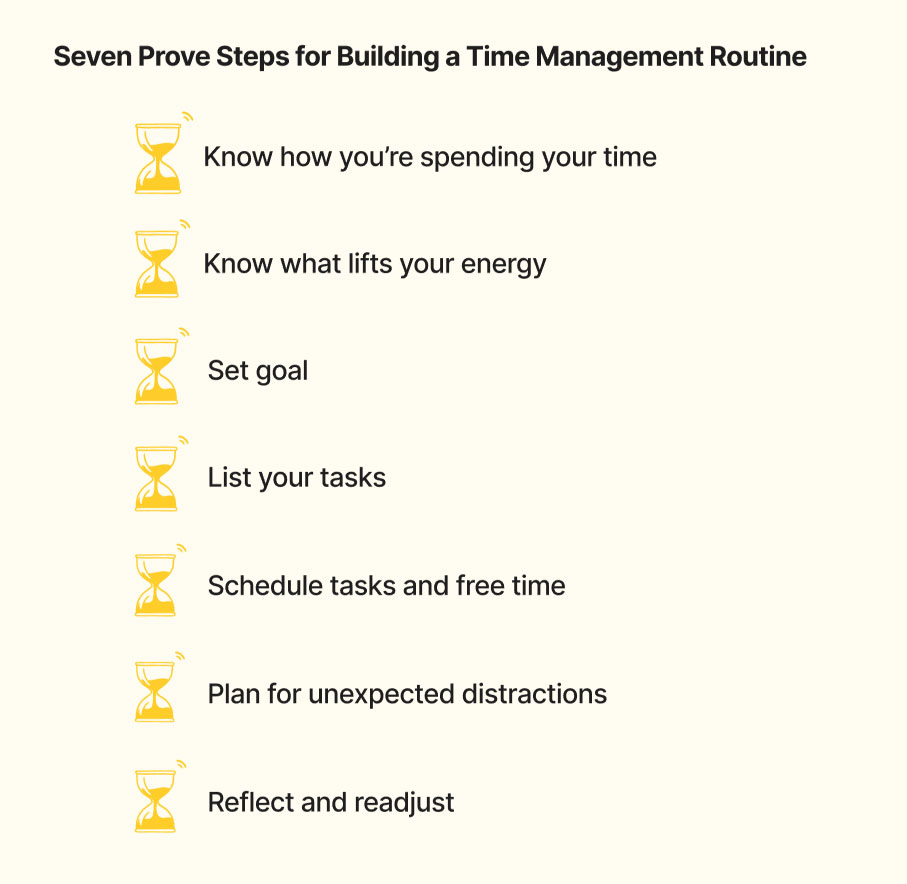
- Understand your current time allocation
- Identify what boosts your energy
- Establish meaningful objectives
- Compile a comprehensive task inventory
- Allocate time slots for tasks and leisure
- Anticipate and accommodate unforeseen interruptions
- Evaluate progress and make necessary adjustments
These strategies are intended to empower you to optimize your time usage, fostering greater joy and satisfaction in your everyday existence.
With that foundation laid, let's dive deeper into the details.
1. Understand Your Current Time Allocation
It is common for people to overestimate their capacity to complete tasks within a given timeframe. Researchers term this the planning fallacy, a cognitive distortion where we systematically undervalue the duration required for activities, fostering undue optimism about completion speeds.
To craft a precise time management routine, perform a thorough time audit. Meticulously log the duration of every task you undertake over the course of a full week.
Numerous methods exist to achieve this, yet they all revolve around the core idea of monitoring the actual time invested in activities that hold significance in your life.
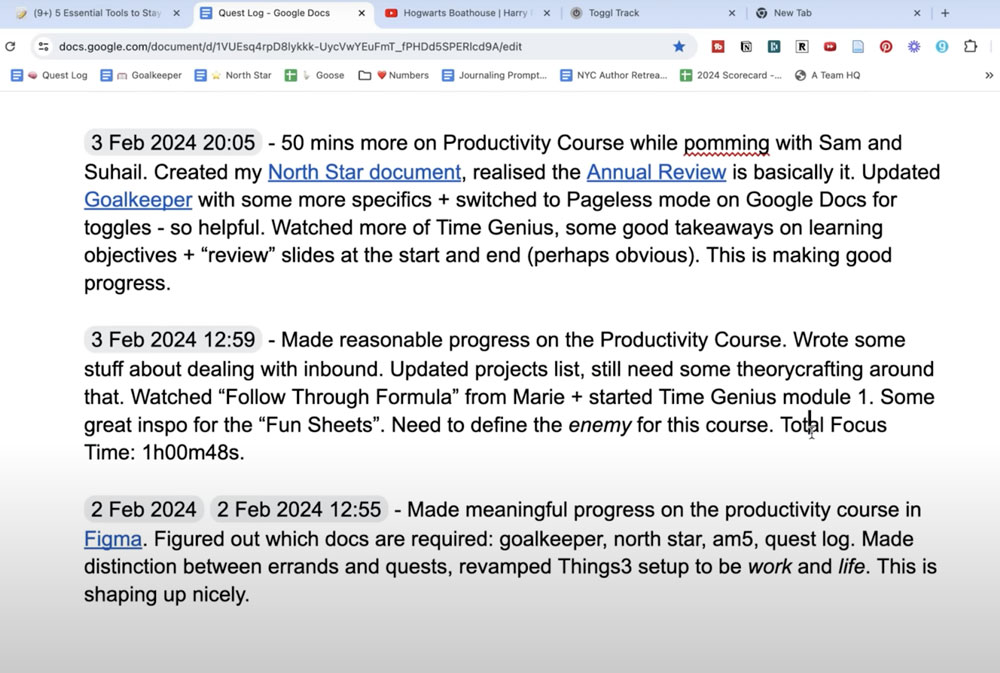
For my part, I have relied on a simple Google Doc dubbed the Quest Log—a playful moniker to enhance engagement. In it, I note the date alongside the task at hand, cue up some inspiring Harry Potter soundtrack, and commence. When concentration wanes, I halt the music, note the elapsed duration, and document it in the log.
This approach offers a straightforward, cost-free, minimal-effort means of time tracking, requiring no specialized software or subscriptions.
Automated Time Monitoring Options
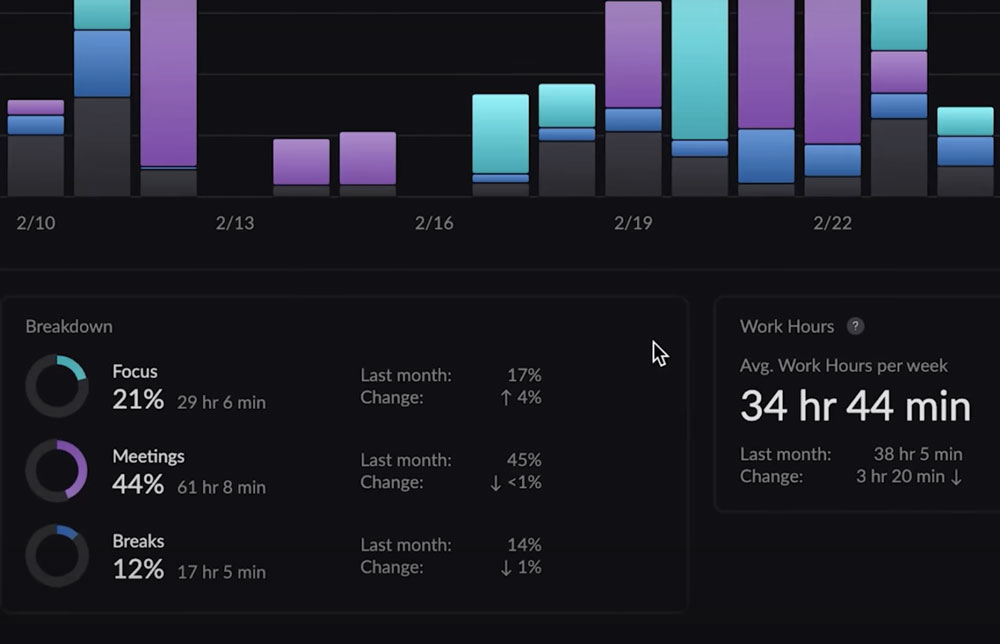
Alternatively, automated tools simplify the process. Since 2021, I have utilized an application called Rize, appreciating its efficacy to the extent that I invested in the company. It passively detects your active applications or websites and assigns categories to your activities accordingly.
For instance, during February 2024, my data revealed 21% of time in focused work, 44% in meetings, and 12% on breaks. My typical workweek spanned 34 hours, with breakdowns showing 44% on video calls, 12% writing, 11% documentation, and 8% design work—which equated to about nine hours sketching in Figma.
I alternate between these manual and automated systems, but virtually any time-tracking tool can serve effectively.
Over that designated week, capture every facet of your day, encompassing professional duties and recreational pursuits alike. Logging comprehensively unveils a holistic picture of your time expenditure.
Consider these illustrative scenarios:
- Morning Routine: Chronicle the full span from awakening to workstation readiness. You may perceive it as a swift 30 minutes, yet reality could reveal a far lengthier process hidden from conscious awareness.
- Gym Sessions: Similarly, account for preparation, changing, post-workout showers, and return travel—not just the weightlifting hour itself.
- Professional Duties: A software engineering role might seem code-centric, but if meetings dominate 60% of your hours, it signals potential for reevaluation.
For granular insights into fleeting digital engagements, activate your device's screen time feature. It generates reports on app, website, and social media usage—often exceeding our self-perceptions.
Grasping these temporal patterns forms the cornerstone of an potent time management routine. Visibility into time sinks empowers you to reclaim agency rather than remaining at time's mercy.
2. Identify What Boosts Your Energy
This phase centers on evaluating how your routine activities influence your vitality.
Execute an energy audit by scrutinizing your weekly calendar. Categorize each entry according to its net effect on your energy—whether replenishing or depleting.
Reflect on specifics: Does a given meeting invigorate or exhaust you? Does your morning ritual propel you forward or hinder momentum?
Color-code accordingly: green for energizers, red for drainers. I annotate directly in Google Calendar, though paper planners or other digital tools work equally well.
Recognize that tasks vary profoundly in impact. Certain ones recharge your reserves, while others rapidly deplete them. Pinpointing these dynamics allows tailoring your time management routine to prioritize vitality, yielding heightened productivity.
3. Establish Meaningful Objectives
Well-articulated goals function as navigational beacons, directing your temporal investments toward priorities.
Lacking such direction, distractions proliferate, diverting effort from aspirations personal and professional alike. Precise goals filter irrelevancies, sustaining momentum toward authentic success and contentment.
Effective goal-setting unfolds in dual phases.
Long-Term Vision: 10-Year Horizons
Begin with expansive thinking. While SMART goals enjoy popularity, my refined method draws from luminaries like Jim Rohn and Zig Ziglar, adapted for contemporary resonance.
Set a 10-minute timer and brainstorm a list of aspirations, dreams, or desires spanning the next decade. Prompt yourself with inquiries such as: What skills to acquire? Possessions to attain? Identity to embody? Experiences to savor?
Excerpt from my own roster:
Sometime within the coming decade, I aim to:
- Master snowboarding
- Cultivate a joyful, nurturing family life
- Author a book titled Time Management for Normal People
- Hone cooking prowess to host delectable dinner parties
Next, append timelines (1, 3, 5, or 10 years) to each:
- Master snowboarding: 1
- Cultivate a joyful, nurturing family life: 10
- Author a book titled Time Management for Normal People: 3
- Hone cooking prowess to host delectable dinner parties: 5
These numerals denote projected achievement windows. A '10' flags a decade-spanning pursuit; a '1' indicates near-term intent. Such markers illuminate life's overarching trajectory without rigid enforcement.
NICE Goals for Immediate Action
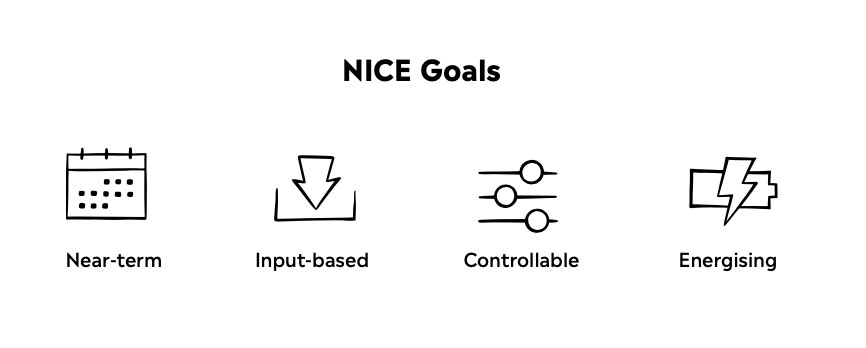
With visions charted, decompose them into actionable fragments via my NICE framework:
- Near-term: Frame goals for daily or weekly attainment, sidestepping big-picture paralysis.
- Input-based: Prioritize processes over outcomes. For my book Feel-Good Productivity, I targeted 100 morning words rather than bestseller status.
- Controllable: Ensure feasibility amid constraints. Unrealistic eight-hour daily writing yielded to sustainable 20-minute sessions.
- Energising: Infuse enjoyment. Transform drudgery via café ambiance or curated playlists for workouts.
Leverage 10-year goals for vision; NICE for tactical execution. Snowboarding's annual aim translates to daily 30-minute balance-strength routines.
4. Compile a Comprehensive Task Inventory
Armed with objectives, enumerate all weekly obligations.
Weekly task listing illuminates impending demands, facilitating organization and sequencing.
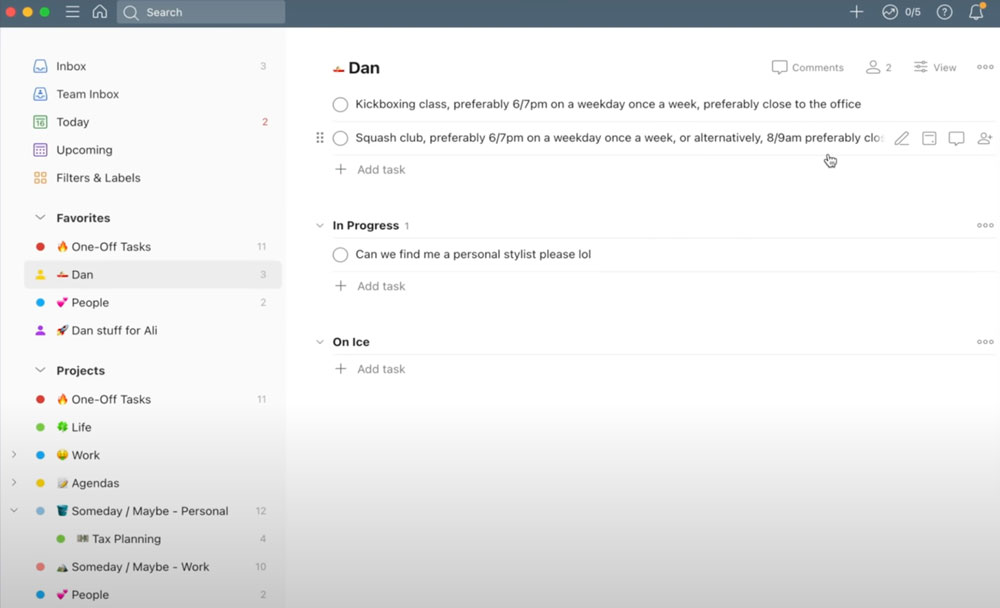
I employ Todoist for this, capturing personal errands like grandparent calls or gym visits alongside professional items such as YouTube script drafting.
To avert oversights, assign recurring dates to regulars, e.g., weekly brother music-and-dinner Tuesdays.
Cross-reference emails for deadlines: team trip planning or sponsor video mandates within days.
5. Allocate Time Slots for Tasks and Leisure
Transition to calendaring every weekly element.
Populate from your task list, informed by audit-derived estimates.
Reserve voids for desirables like piano or coding lessons.
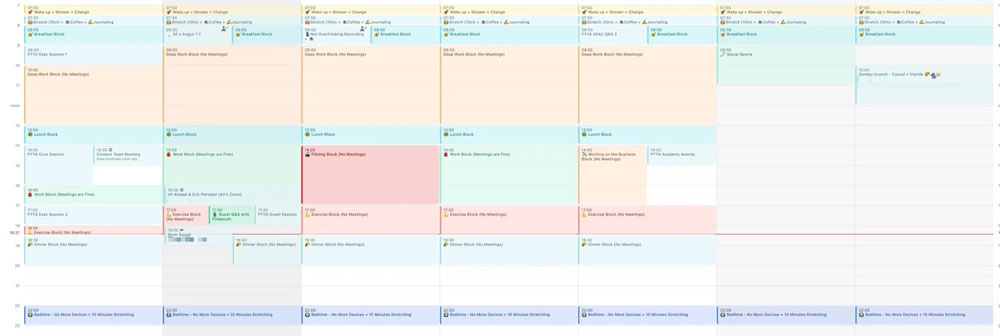
Conceive it as restaurant reservations: pre-booking secures your spot. Time blocking analogously safeguards task slots.
This has proven invaluable for consistencies like my LifeNotes newsletter—dedicated windows dramatically boost completion rates.
Mastering Prioritization
Faced with abundance, query: Does this advance my goals?
Elevate goal-aligned items for daily progress.
Misalignments warrant delegation or elimination, preserving bandwidth for essentials.
Consult energy audit: Will calendared items net positive vitality?
For drainers, probe:
- Is this necessary?
- Must I personally execute it?
- How to enhance enjoyment?
Delegation varies in ease; some unenjoyables persist. Aim to minimize within practicality.
6. Anticipate and Accommodate Unforeseen Interruptions
Incorporate buffers for surprises in your blueprint.
Account for impromptu meetings, colleague queries, or overruns. Padding equips resilience.
Surplus buffer advances subsequent tasks or affords respite.
Embrace adaptability—life's unpredictability demands it. Deviations needn't derail; the blueprint guides approximate adherence.
7. Evaluate Progress and Make Necessary Adjustments
Conclude weeks with reflective review of triumphs and tweaks.
Prolonged tasks or unexpected drainers surface for refinement.
Iterative assessment hones efficacy, aligning strategies with evolving needs.
It verifies goal traction: Lagging snowboarding prep after half a year might necessitate doubled gym blocks.
Such reflections anchor communities like Productivity Lab, where members celebrate wins and ideate enhancements.
Invest in What Truly Matters
Though demanding, time management ranks among premier modern skills.
Beyond task-cramming, it ensures alignment with personal priorities. Goals, lists, buffers, and reviews revolutionize daily navigation toward productivity and purpose.
Initiate with time and energy audits plus goal-setting—quarterly suffices.
Weekly, Sunday evenings suit task listing and calendaring for foresight.
End-week reviews facilitate tuning.
Persistence yields temporal mastery.
Subscribe to the newsletter
Join 50,000+ others who get our content first. No spam, ever.